
Navodaya Vidyalaya vs. Sainik School: The Ultimate Guide for Parents
Every year, thousands of families apply to both Navodaya Vidyalaya and Sainik School simultaneously. On the surface, the reasoning makes sense: both are government-run, CBSE-affiliated, and residential schools with nationwide...
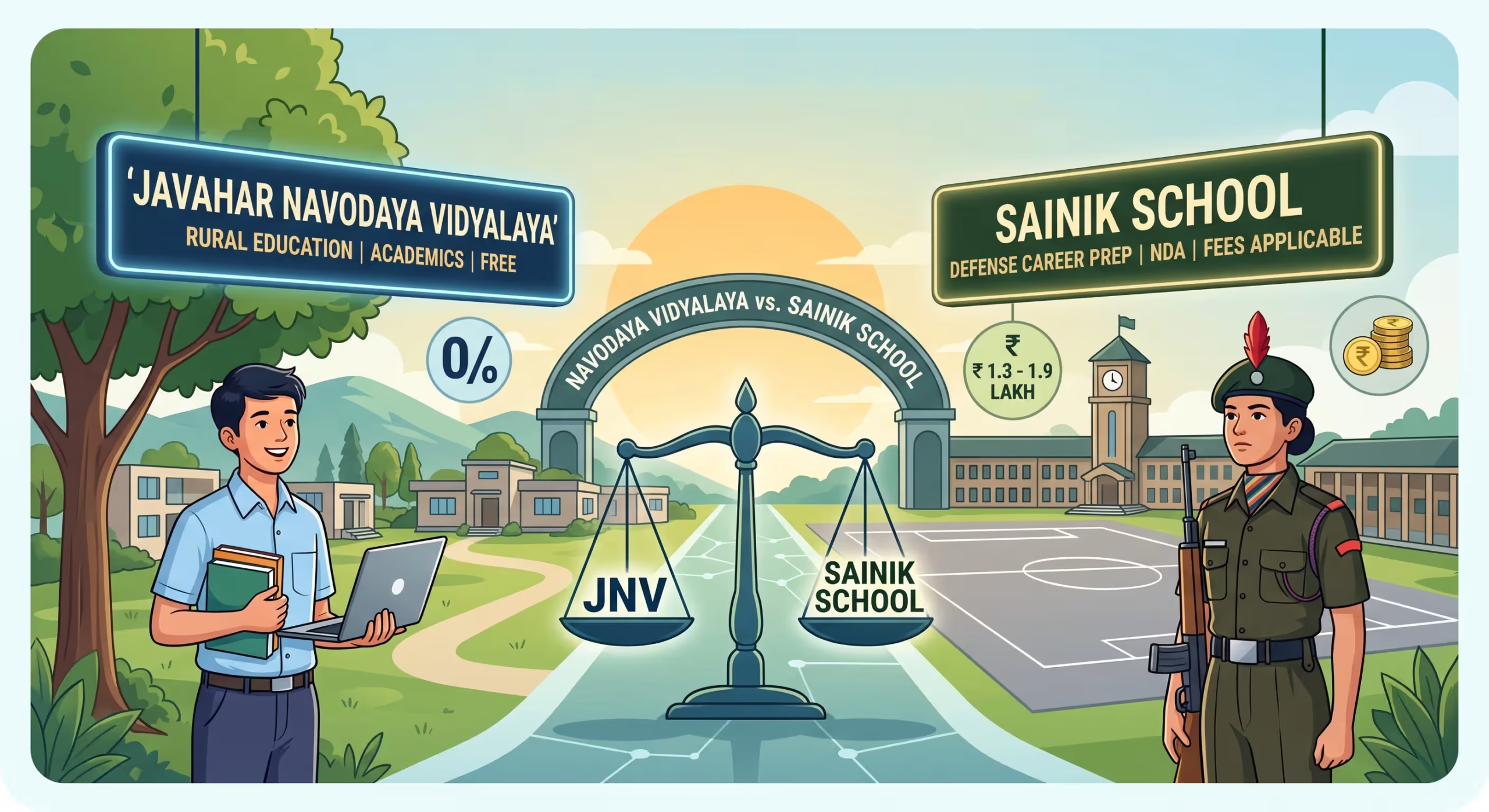
Every year, thousands of families apply to both Navodaya Vidyalaya and Sainik School simultaneously. On the surface, the reasoning makes sense: both are government-run, CBSE-affiliated, and residential schools with nationwide networks.
However, treating these two institutions as interchangeable options for the same goal is a common misconception. Navodaya Vidyalayas and Sainik Schools were built with fundamentally different purposes, serve different student profiles, and produce entirely different outcomes. Let’s break down the real differences to help you decide which environment fits your child’s needs.
Quick Comparison Overview
| Feature | Jawahar Navodaya Vidyalaya (JNV) | Sainik School |
| Primary Mission | Rural educational equity and holistic academics | Defense career preparation (NDA) |
| Eligibility | Rural students only (for Class 6 entry) | Open to both urban and rural students |
| Financial Cost | Fully funded (Free tuition, boarding, meals) | Rs 1.3 lakh to Rs 1.9 lakh annually |
| Entrance Exam | JNV Selection Test (JNVST) | All India Sainik Schools Entrance Exam (AISSEE) |
Understanding the Core Missions
Jawahar Navodaya Vidyalayas (JNV) The driving mission of JNVs is educational equity. These schools aim to provide free, quality education to talented children from rural areas who might otherwise lack access to residential education. While they build academically strong and well-rounded students, they are not specifically defense-oriented. JNV alumni frequently go on to the IITs, IIMs, UPSC, and various other competitive careers.
Sainik Schools Sainik Schools are established primarily to prepare students for defense careers, especially for entry into the National Defence Academy (NDA). Every structural element of a Sainik School—from physical training to military-pattern daily routines—is oriented toward producing NDA cadets.
The Admission Process: JNVST vs. AISSEE
The pathways to entering these schools are just as different as the schools themselves.
JNVST for Navodaya Vidyalaya:
- Admission is highly competitive and primarily conducted through the JNV Selection Test (JNVST) for Class 6, with a separate test for Class 9.
- Only students from rural areas are eligible for Class 6 admissions; urban students cannot apply.
- The JNVST tests Mental Ability, Arithmetic, and Language.
- The exam does not include Science, General Knowledge (GK), or Intelligence sections.
- The paper is provided in regional languages and Hindi.
- Parents can check individual results on navodaya.gov.in using the candidate’s roll number and date of birth.
AISSEE for Sainik School:
- Admission is routed through the All India Sainik Schools Entrance Examination (AISSEE) for Classes 6 and 9.
- The AISSEE is open to both urban and rural students.
- The exam covers a broader range of subjects, testing Mathematics, Language, GK, and Intelligence.
- Selection includes a written exam, a medical examination, and category/domicile reservations applied through AISSAC e-counselling.
- Sainik Schools require a Physical Efficiency Test prior to admission, which is completely absent from the JNV process.
The Financial Reality (Fees)
This is the most significant practical difference between the two institutions.
- JNVs are completely free to attend.. The central government fully funds the education, including academics, boarding, meals, and uniforms. Families pay zero tuition, hostel, or meal charges, making it genuinely accessible across all income levels.
- Sainik Schools require an annual fee.. Fees range from Rs 1.3 lakh to Rs 1.9 lakh depending on the specific school. While there are concessions for SC/ST families and Defence category wards, it is a real cost that families must budget for.
Curriculum and Daily Life
Academically, both schools follow the CBSE syllabus and align with national standards for subjects like Mathematics, Science, Social Studies, English, and Hindi. The true distinction lies in the daily routine outside the classroom.
- Life at JNV: The day beyond academics includes sports, cultural programmes, and community activities. While the residential environment is structured and disciplined, it does not involve military-pattern physical training or parades.
- Life at Sainik School: The daily routine is explicitly military-pattern. Students participate in daily physical training (PT) at 5 AM, parades, military drills, and NCC integration. The peer environment is heavily built around defense aspirations.
Which School Should You Choose?
If your child received allotments from both processes, you must compare the specific JNV against the specific Sainik School based on your child’s aspirations and your financial situation. There is no universal right answer, but here is a guide to finding the right fit:
Choose Sainik School if:
- Your child’s primary aspiration is a career in the armed forces via the NDA.
- Your child wants a military-pattern residential environment focused on discipline, PT, and parades.
- Your family can comfortably manage the annual fees.
- Your child scored competitively in the AISSEE and received an allotment.
Choose Navodaya Vidyalaya if:
- Your child is from a rural area and would otherwise lack access to quality residential education.
- Your child’s career goal is focused on strong general academics leading to competitive fields (like engineering or civil services) rather than specifically defense.
- Zero cost is a critical factor for your family.
- Your child secured an allotment through their JNVST score.